India celebrates its sixtieth year of Independence today. While the first few decades were kind if sleepy, India really took off post 1991 when the then Prime Minister PV Narasimha Rao launched key reforms that liberated the economy. PVNR in that aspect held fort for give good years and did more good for India than any other Prime Minister before him.
For those whose youth has coincided with this phase, the experience of India is vastly different from their parents' who witnessed a youth of shortages, high unemployment and denial of basic goodies in life - telephones, cars, air conditioners etc all due to the government wanting to regulate supply. Governance and politics is still not very good but hopefully with the new generation knocking on the doors, things will change soon. Business Standard has a nice editorial today, aptly titled Chak De India.
I wistfully imagine what would have been possible if India had not undergone partition. A freedom struggle that was by and large non-violent thanks to Gandhi culminate in gruesome murders of five million Indians. A more assertive freedom struggle early on would have perhaps taken a far lesser toll of lives, and realised freedom faster. And in the process the manipulations of the British to divide India would not have succeeded. A United India could have emerged faster sans the Kashmir, Bangladesh turmoils. Enough has been said about the personalities and egos of Nehru and Jinnah, the chief players at the time of Partition and Independence.
Anyway the story of India's growth is now sixteen years young and holds as much promise as our last tryst with destiny in 1947. I will any day prefer this sweet sixteen to sixty!
Showing posts with label United States of India. Show all posts
Showing posts with label United States of India. Show all posts
Aug 15, 2007


May 20, 2007
Prosperous India by 2025!
Here is what I took away (in my words again) from Gurcharan Das on his predictions about future growth in India. This in continuation to my previous post on this topic.
"The most remarkable thing about the first quarter of 21st century will not be the 9/11 attacks in US, but the rise of India and China. In the year 1750 most nations of the world were more or less equally well off (or worse off). The industrial revolution bought tremendous prosperity to the West in the 19th century; something similar happened in the Far East during 1950 to 1990. But by 2025 the wheel would have started turning full circle for India and China with their economies achieving critical mass.
"The Middle Class was about 8% of the total population in India in 1990. Today it is 28%! And NCAER predicts that by 2020, it will cross to about 50% of the population. This will happen in about two-thirds of India and the rest (the likes of Bihar) will take some 20 more years to catch-up. You could draw an imaginary line from Kanpur to the southern tip of Andhra Pradesh - the areas west of this line will fall in this 2/3rds (you may have to cheat and swap Coastal AP with Telangana). Now such regional disparities are bound to occur as you have Gujarat's economy growing at 12% compared to Bihar at 1.1%. In the USA too, the American South was dirt poor till the Second World War but the invention of air conditioning drastically changed everything with cities like Houston, Dallas and Atlanta booming. Similarly Italy and Spain were also poor compared to the rest of Western Europe till the First World War. Obsession with only inequality is misguided as it risks pulling back everyone; what is needed it creating an environment to lift the poor. In this context internal migration will perhaps be our safety valve - the Indian Railways sells about 4.8 billion tickets a year, that is almost 4 journeys per person per year!
"The net result is that by 2025 the number of poor in India will reach a manageable proportion! Of course all the above will need good institutions that ensure law and order, stable governance and property rights".
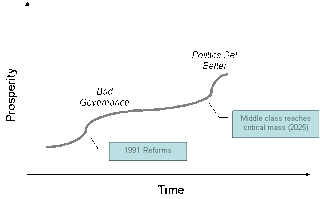
Now there is a S-curve relationship between prosperity and governance. As governance improved in India beginning 1991, prosperity increased and now we have been seeing 8%+ growth rate in the GDP for past several years. But as the size of the government has decreased in relative terms to the size of the economy, the quality of governance has dipped with politicians seeking as much 'rent' as possible from their positions before getting voted out in the next election. This has an adverse impact on further growth of prosperity. For more growth, a reform in governance has to occur and the hunch is this will 'automatically' happen as the middle class becomes sizeable. Then we will truly see an acceleration in India's growth and we will be well on our way!
"The most remarkable thing about the first quarter of 21st century will not be the 9/11 attacks in US, but the rise of India and China. In the year 1750 most nations of the world were more or less equally well off (or worse off). The industrial revolution bought tremendous prosperity to the West in the 19th century; something similar happened in the Far East during 1950 to 1990. But by 2025 the wheel would have started turning full circle for India and China with their economies achieving critical mass.
"The Middle Class was about 8% of the total population in India in 1990. Today it is 28%! And NCAER predicts that by 2020, it will cross to about 50% of the population. This will happen in about two-thirds of India and the rest (the likes of Bihar) will take some 20 more years to catch-up. You could draw an imaginary line from Kanpur to the southern tip of Andhra Pradesh - the areas west of this line will fall in this 2/3rds (you may have to cheat and swap Coastal AP with Telangana). Now such regional disparities are bound to occur as you have Gujarat's economy growing at 12% compared to Bihar at 1.1%. In the USA too, the American South was dirt poor till the Second World War but the invention of air conditioning drastically changed everything with cities like Houston, Dallas and Atlanta booming. Similarly Italy and Spain were also poor compared to the rest of Western Europe till the First World War. Obsession with only inequality is misguided as it risks pulling back everyone; what is needed it creating an environment to lift the poor. In this context internal migration will perhaps be our safety valve - the Indian Railways sells about 4.8 billion tickets a year, that is almost 4 journeys per person per year!
"The net result is that by 2025 the number of poor in India will reach a manageable proportion! Of course all the above will need good institutions that ensure law and order, stable governance and property rights".

Now there is a S-curve relationship between prosperity and governance. As governance improved in India beginning 1991, prosperity increased and now we have been seeing 8%+ growth rate in the GDP for past several years. But as the size of the government has decreased in relative terms to the size of the economy, the quality of governance has dipped with politicians seeking as much 'rent' as possible from their positions before getting voted out in the next election. This has an adverse impact on further growth of prosperity. For more growth, a reform in governance has to occur and the hunch is this will 'automatically' happen as the middle class becomes sizeable. Then we will truly see an acceleration in India's growth and we will be well on our way!
Subscribe to:
Posts (Atom)


 Posts

